Responsive Parenting Hub
Honest Help For Parents Who Are Trying Their Best
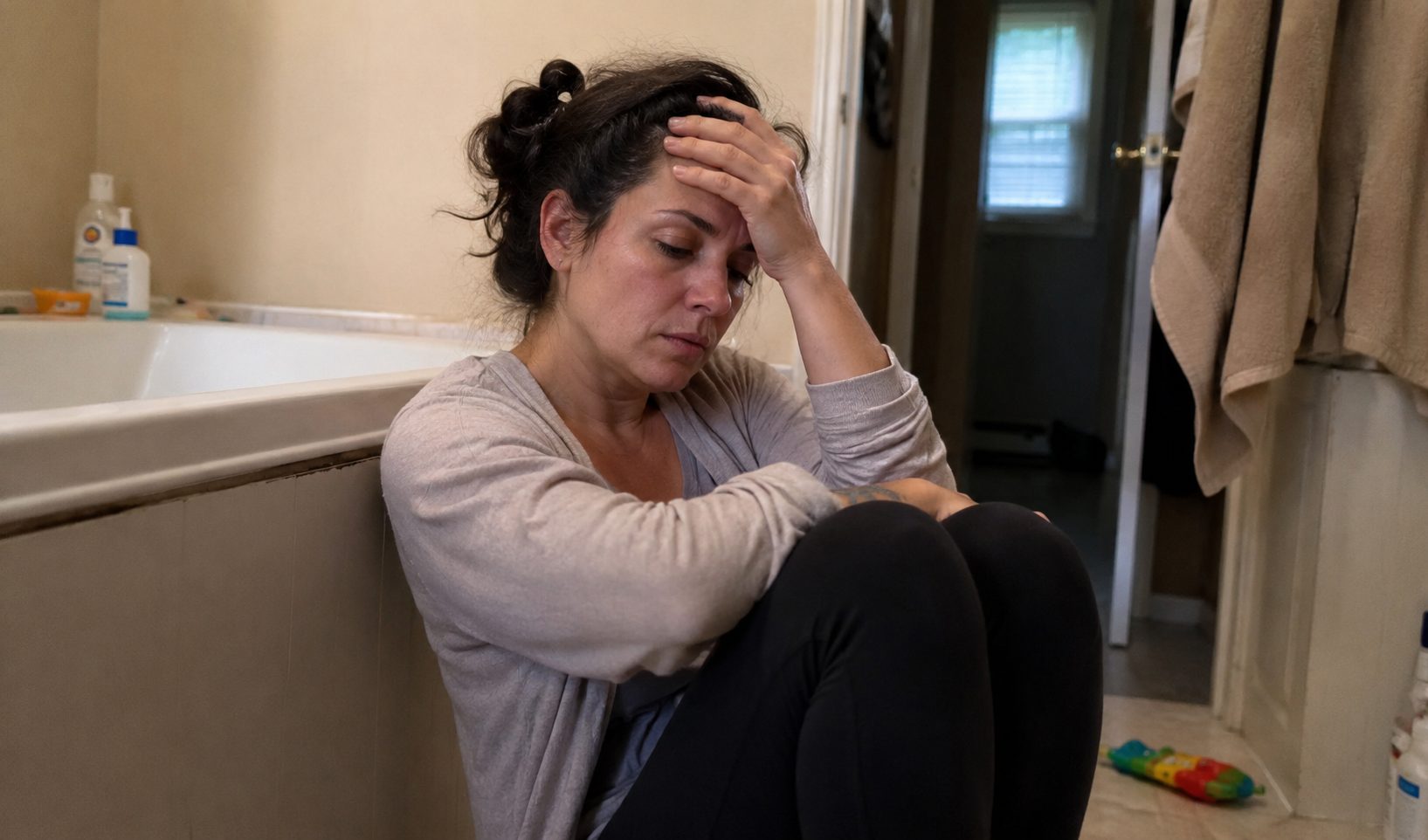
For years, this was me every single morning:
I Promised Myself I Wouldn't Yell Today. It's Not Even Noon Yet, and I've Already Broken That Promise Again.
I lived that loop for years, until a stranger crying in a supermarket aisle showed me the hidden reason I couldn't stop. Here's how I went from yelling daily to a calm, connected home in 29 days, with just five minutes a day… and why I almost kept this to myself.
"What is wrong with me?"
"I love this child more than my own life."
"So why can't I just… stop?"
I have asked myself those three questions hundreds of times.
I've asked them with my hand pressed hard over my own mouth, trying to muffle the crying so my daughter wouldn't hear. I've asked them lying awake at 2am, staring at the ceiling, replaying the look on her face like a wound I couldn't stop touching. I've asked them standing in a kitchen full of the silence that comes after, the worst silence in the world, certain I was the most terrible mother who had ever lived.
Maybe those words sound familiar. Maybe they don't. I'm not going to presume to know what your mornings look like.
But I'll tell you exactly what mine looked like, and if any of it lands close to home, I think the next few minutes might be worth your time.
Here's how mine went.
I'd make the promise at breakfast. A real one. I'd look at that small, sweet face across the table and something in my chest would soften, and I'd swear it: today I will be patient. Today I will not raise my voice. Today I'll be the mother she deserves.
And I meant it. With everything in me.
Then it wasn't even noon. The juice would spill, or the shoes wouldn't go on, or I'd hear "why?" for the fortieth time, and something inside me would snap like a wire pulled too tight. And a voice would come out of me that was too loud, too sharp. A voice that didn't sound like me at all.
I'd watch that little face change. The flicker. The flinch. That half-second where my daughter pulled back from me, the one person on this earth who was supposed to be her safest place.
And my stomach would drop straight through the floor.
By nightfall the guilt was so heavy I could barely carry it up the stairs. I'm failing her. I'm the reason this house feels like this. What is wrong with me?
And the most crushing part, the part that kept me awake, was that I had no idea how to stop. I'd tried. God knows I'd tried. And every night, despite every promise, I was terrified it was going to happen all over again tomorrow.
If you've read this far, you already know why.
Nobody reads a stranger's confession about yelling at her child for four minutes out of idle curiosity.
So let me say the thing I most needed someone to say to me, back then:
There is nothing wrong with you.
You are not broken. You are not a bad parent. You are not "too angry" or "not cut out for this."
You are a good parent, a loving parent, who has been trying to solve this the way everyone told you to, with the one tool that was never, ever going to work. And once you see the real reason this keeps happening (a reason almost no one talks about), everything changes. It changed everything for me.
But before I show you that, I have to be honest with you about who I used to be.
Because I didn't learn this from a book, or a course, or a degree on a wall.
I learned it the hard way, on the floor of my own bathroom, at the lowest point of my life as a mother. This is the story I almost never told anyone.
Not because I'm ashamed of where I ended up.
But because I'm ashamed of who I was before.
The Night She Went Quiet
It was an ordinary evening. Nothing special about it. Dinner, baths, the same chaos as every other night.
Mia wouldn't get in the tub. That was it. That was the whole crime. A tired four-year-old, not wanting a bath.
But I was tired too. Not sleepy-tired. Bone-tired. The kind of exhaustion that hollows you out until every small "no" lands like a slap. I had nothing left. And that one word was the last thing my empty tank could hold.
So I broke.
I won't write down what I screamed. Even now, years later, sitting here typing this, my throat closes and my eyes sting just remembering it. But I can still hear it, my own voice, too loud, ricocheting off the bathroom tiles. A voice I didn't recognize. A voice that didn't sound like a mother at all.
And then I watched it happen in slow motion.
I watched Mia's eyes go wide. I watched her bottom lip pull in and disappear between her teeth. I watched those small shoulders climb up, up, up toward her ears, a little body trying to make itself smaller. Trying to disappear.
And then… nothing.
No crying. No screaming back. No tantrum.
Just silence.
She had gone completely still. Quiet in the way you go quiet near something dangerous. Still the way a small animal goes still when the thing hunting it is too close to outrun.
I stood there in that bathroom, and a thought arrived that dropped me straight down onto the cold tile:
I couldn't breathe. I genuinely could not pull air into my lungs.
This tiny person. The one I had begged God for. The one whose first cry made me sob with joy. The one I would step in front of a truck for without a second's hesitation…
…was flinching. From me.
I was supposed to be her safe place. The one person in the world whose arms meant nothing can hurt you here.
Instead I had become the thing she needed to be kept safe from.
I slid down against the side of the tub, pressed my hand over my mouth so she wouldn't hear, and cried until my whole body shook.
And here's the part I need you to understand, because it's the reason any of this matters:
That night wasn't the problem. One bad night, you can eventually forgive yourself for.
What was destroying my home was what happened next, and it happened every single day, on a loop I could not get off, no matter how hard I clawed at it.
The Loop That Was Quietly Killing My Home
It went like this.
I'd yell. And the instant the words left my mouth, the guilt would crash in, not gentle guilt, but a black, drowning guilt that sat on my chest like a slab of stone.
So I'd overcorrect. Hard. Suddenly I was too soft, too permissive, saying yes to everything. Buying the toy. Dropping the boundary. Apologizing to Mia over and over like a woman begging for a forgiveness she was certain she didn't deserve.
But all that permissiveness bred more chaos. More whining, more pushing, more meltdowns. And more chaos wore down the last scrap of patience I had left.
And a mother running on fumes…
…yells again. Louder than before.
And the guilt comes back heavier than before.
The worst part was watching it seep into my daughter.
Mia started apologizing for things that weren't her fault. Small, flinching "sorry"s, thrown out before I'd said a word. Just in case. She got quieter around me. More careful.
Because here's what nobody warns you about: children don't become what you tell them to be. They become what you are.
My home stopped feeling like a home.
It became a place where everyone braced. Where even the air felt tight.
And every night, lying in the dark next to a husband who didn't know how to help me, I'd whisper the same broken sentence at the ceiling:
How could a love that enormous and a rage that ugly live inside the same body?
I didn't have an answer. And every day I went without one, I became a little more certain that I was simply, fundamentally, a bad mother. Broken. Beyond repair.
I Tried Everything. All of It Failed.
Let me be clear about something: I was not a lazy mother sitting on her hands.
I was desperate. I would have done anything.
I read the books. All of them. Every gentle-parenting, peaceful-home, calm-mama book with a soft pastel cover, the ones that somehow only made me feel worse, because clearly the women who wrote them had cracked a code I was too broken or too stupid to understand.
I tried count to ten. I'd make it to about three before the words were already out.
I tried deep breathing. I tried sticker charts, for myself. A grown woman. Rewarding herself with a gold star for not screaming at a four-year-old.
And I tried gritting my teeth every morning and making that promise. Today. Today I will be different. Today I will not yell.
Every single method failed me. Every one. And they all failed for the same reason, a reason it took me years and far too many tears to finally understand.
The Hidden Reason I Couldn't Stop
Here's the truth that cracked the whole thing open. I'd ask you to read this part slowly, because it's the thing that set me free.
Every method I had ever tried was built on the same silent, invisible assumption:
That yelling was a choice. A patience problem. A discipline problem. Something I could fix if I just decided hard enough. Wanted it badly enough. Tried a little harder.
But yelling isn't a decision.
By the time you hear yourself yelling, the "decision" was already made, about half a second earlier, by a part of your brain that never stopped to ask your permission.
Here's what's actually happening in there.
When an exhausted, overstimulated parent gets pushed past a certain invisible line, the body flips into survival mode. Fight-or-flight, the same ancient alarm that would fire if a lion walked into the room. Heart pounding. Chest tight. And the rational, thinking part of the brain, the calm, patient part that knows better, goes quiet. The reaction fires before the reasoning ever gets a word in. This isn't my theory. It's the same stress response researchers have described for decades, we just never thought to apply it to a Tuesday morning in our own kitchens.
Yelling is simply the "fight" in fight-or-flight.
It's biology. Not character. Not a lack of love. Biology.
Which means, and this is the sentence that changed my life,
It isn't possible. That's why "count to ten" never worked. That's why "just be more patient" never worked. I was trying to fight a lightning-fast survival reflex with a slow little to-do list.
I was bringing a sticky note to a gunfight.
And it gets crueler.
Remember that guilt loop? That drowning shame after every blow-up? Guilt keeps the body flooded with stress hormones. Which means every time I beat myself up for yelling, I was actually lowering my own threshold for the next explosion.
The shame wasn't just torture.
I remember reading all of this and just… stopping. Sitting perfectly still. And then crying, but this time, for the first time, not out of despair.
Out of relief. The purest relief I have ever felt.
Because in that moment I finally understood:
Nobody had ever shown me how to work with my own nervous system instead of white-knuckling against it every day. Not the books. Not my own mother. Not the pediatrician. Nowhere.
It was never a flaw in my heart. It was a gap in my knowledge.
And a gap in knowledge can be filled.
What Came Back (I Still Can't Write This Part Without Crying)
I won't lie to you and pretend I transformed into some serene, glowing goddess of a mother who floats through the house radiating peace. That woman is a myth. If you ever actually meet her, throw a shoe at her on behalf of the rest of us.
I still get frustrated. My kids can still find and press every single button I own.
But everything is different now. Because now, there is a gap.
A small, sacred pause between the trigger and the reaction. And inside that little pause, I get to choose who I want to be. The reaction doesn't own me anymore. I hold the reins.
The yelling didn't just "reduce." It faded out of the rhythm of our home almost entirely. And into the empty space where it used to live rushed the one thing I'd been most terrified I had destroyed forever:
Connection.
Mia climbs into my lap again now, on her own, unasked. She tells me the small, silly, precious secrets that children only ever share when they feel completely safe. The eggshells are gone. Bedtimes are soft and slow and full of giggles now, instead of tension and tears.
And I will never forget the first time, a few weeks into all of this, that she threw both little arms around my neck, completely out of nowhere, and whispered:
I had to walk out of the room so she wouldn't see me fall apart.
That is what came back to me. And the moment I held it in my hands again, I knew, with total, bone-deep certainty, that I would do anything, give anything, to never, ever lose it again.
By the way, my name is Catherine.

And back then, I had no idea that what I'd just lived through was about to become something far bigger than my own little family.
How a Little Page Became 625,000 Parents
I never planned to become "the parenting lady on the internet." That was never the goal. Not even close.
I just started writing down what I was learning. The real stuff. The practical, day-by-day, this-actually-works stuff. And I started quietly posting it, mostly for other drowning parents like the woman I used to be.
I honestly never thought a single soul would notice.
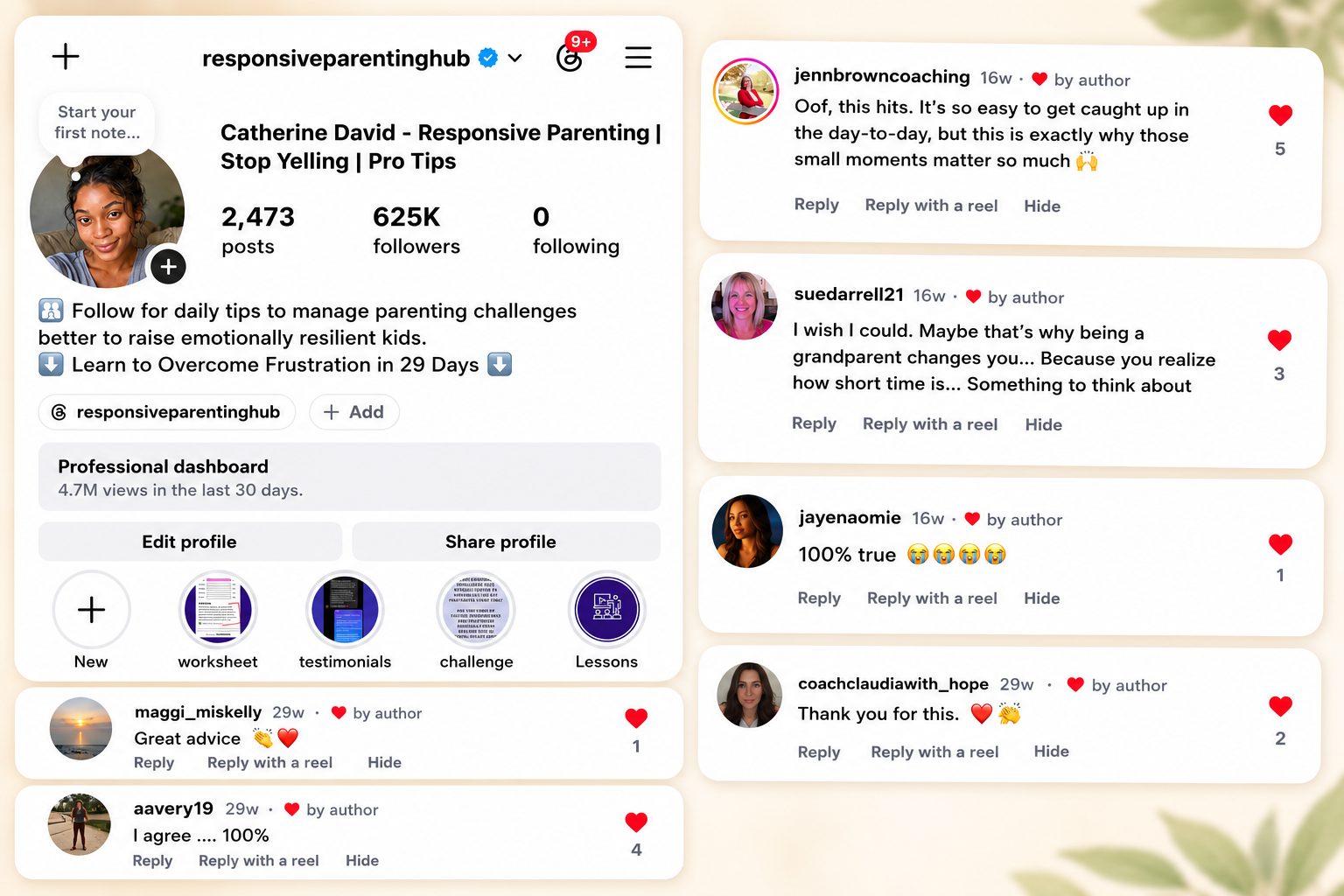
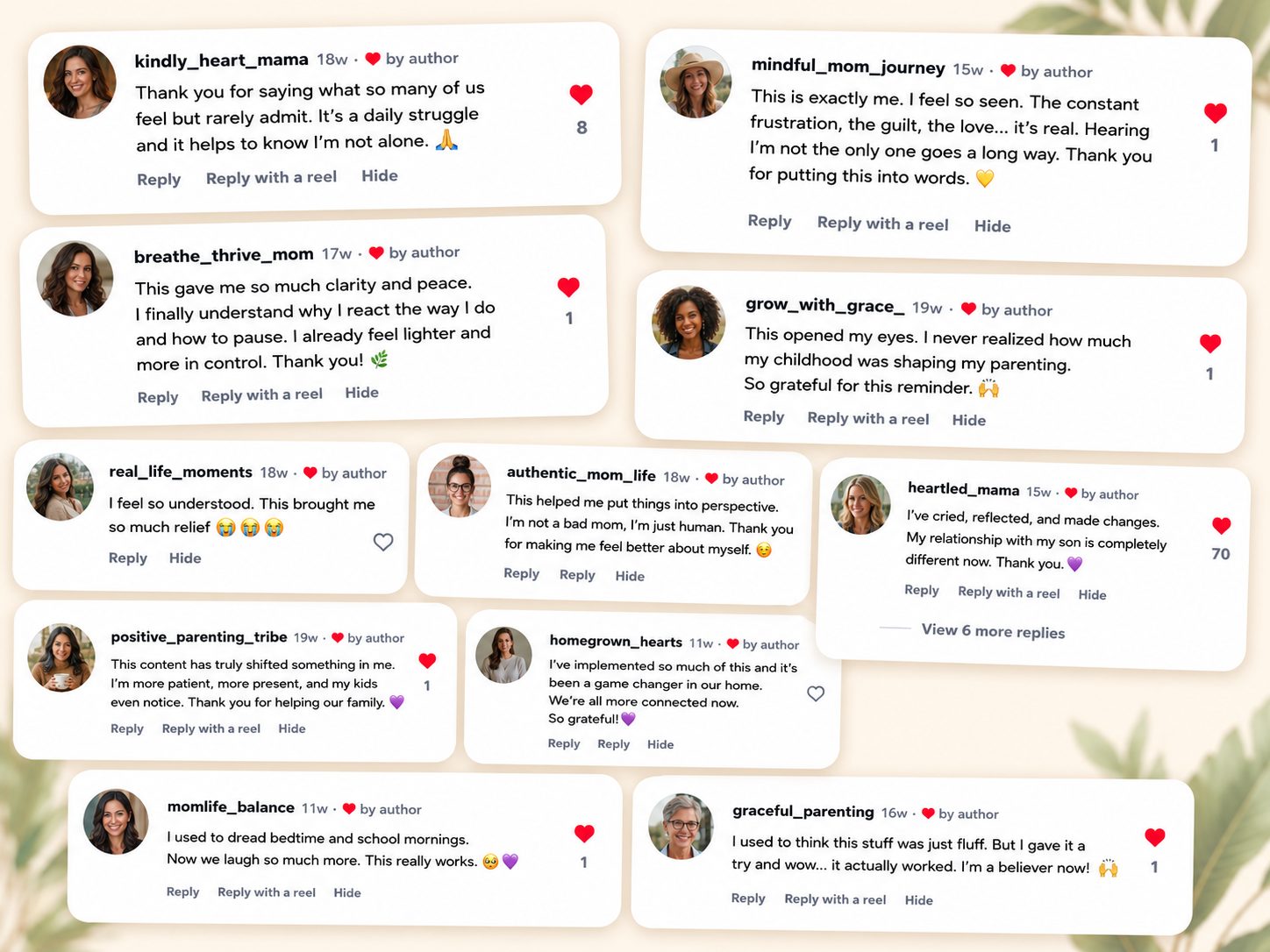
But something in those words struck a nerve. One post reached a few people. Then a few thousand. Then the messages started pouring in, thousands upon thousands of them, all saying versions of the exact same thing:
"I thought I was the only one."
"I read this at 2am and I cried."
"How did you know exactly what my house feels like?"
That tiny little page grew into Responsive Parenting Hub, and today, more than 625,000 parents open it every single morning, learning how to stop yelling and raise emotionally strong, resilient, deeply connected kids.
I don't tell you that number to impress you. I tell you because I need it burned into your heart right now:
There are 625,000 of us, six hundred and twenty-five thousand, quietly carrying the very same secret guilt that is sitting on your chest as you read these words.
But even with all of that… I still had not created the one thing I'm about to share with you.
Not until one completely ordinary Tuesday morning. In a supermarket. When a stranger on the floor broke my heart wide open.
The Woman on the Floor in Aisle Seven

I almost walked right past her.
She was crouched low by the bottom shelf, half-tucked behind her cart, curled in on herself the way people curl up when they're trying desperately to cry without being seen. And beside her, strapped into the cart, two small faces watched their mother come apart and didn't understand why.
Twins. A boy and a girl. Five years old. Same wide, worried eyes, both fixed up at Mommy.
I don't know what made me stop. I just did. I crouched down next to her on that cold supermarket floor and asked, quietly, if she was okay.
And it all came pouring out of her, the way it only pours out of someone who has been holding far too much, for far too long, with nobody to tell it to.
She was yelling at them. Every day. She couldn't stop, no matter how hard she tried.
And that morning it had finally come to a head.
Because that morning, her daughter had looked up at her with tears streaming down her face and cried:
And her son, five years old, had folded his arms tight across his chest, and with a trembling lip said the words that shattered her:
And then both of them, together, through their tears: "I hate you."
She told me she'd had to pull the car over on the way to the store because she was crying too hard to see the road. She told me she was certain, absolutely certain, that she had already broken something between herself and her babies that could never be put back together. That she'd damaged them for life. That she was the worst mother who had ever lived.
I knew every word of that sentence. I had said it to my own ceiling, in the dark, for years.
So I sat all the way down, right there on that dirty floor beside her. And I told her everything I've just told you.
That it wasn't her fault. That it wasn't a flaw in her heart, it was a reflex, firing half a second ahead of her, in a body that had been running on empty for too long.
That "I hate you" from a five-year-old is not a verdict. It's a flare. A distress signal, fired off by a tiny nervous system that's completely overwhelmed, because the big nervous system it depends on for safety is overwhelmed too. Her children didn't hate her. They were frightened, and they didn't have the words yet, so they reached for the biggest ones they knew.
And then I told her the thing she needed to hear more than anything in the world:
I watched it land. That same wave of relief that had once washed over me on my own bathroom floor, now washing over a stranger in aisle seven. I watched her shoulders drop for what looked like the first time in months. I watched her breathe.
When we finally stood up, she held onto my arm and wouldn't let go.
She said it was the first thing in longer than she could remember that had made her feel like she wasn't a monster.
And then she asked me a question I haven't been able to shake since.
She said: "Okay. So what do I actually do tomorrow morning?"
And I opened my mouth.
And I gave her everything. The breathing. The pause. The body reset. The repair script for after a blow-up. The trigger tracking. I stood there in the middle of aisle seven and poured six years of hard-won knowledge over a woman who had been crying on the floor thirty seconds earlier.
And I watched her eyes go glassy.
I watched her nod, and nod, and keep nodding, the way you nod when you have stopped absorbing and started drowning. She pulled out her phone to write it down, and her hands were shaking, and after a moment she just… put it back in her pocket.
And she said, very quietly:
That sentence went through me like a spike.
Because she was right. She couldn't hold it. Not that morning. Not with two five-year-olds in a shopping cart and no sleep and "I hate you" still ringing in her ears.
I hadn't given her a rescue rope. I'd handed a drowning woman an instruction manual.
What I Realized in the Car
I drove home that day and I couldn't stop hearing her. I don't think I can hold all of that.
And it finally landed on me, the thing I'd been missing for years, in plain sight, the entire time.
The parents in my messages didn't have a knowledge problem. They were swimming in knowledge. They'd read the same books I had. They knew about deep breathing. They could recite the tips back to me.
They had a sequence problem.
Nobody had ever said: do this one thing. Only this. Today. And then, tomorrow: now this, and it'll work now, because you did yesterday's.
That's the difference between a page full of tips and a path.
A tip is something you scroll past on Monday and forget by Tuesday. A path is something you can stand on.
That woman didn't need more hope. She didn't need more information, God knows she had enough of that.
She needed someone to take her hand and say: five minutes. Today. Just this one thing. I'll be here tomorrow with the next one.
She needed 29 days.
So I sat down that night and started building them.
And that was how the 29-Day Challenge to stop yelling and overcome your frustration was born, built on what I now call the 3-Second Gap Method.
Introducing: The 3-Second Gap Method

I called it The 3-Second Gap Method, because that's exactly what it builds inside you.
Remember what I told you earlier? That yelling isn't a decision. That by the time you hear yourself, the reaction already fired, half a second ahead of your thinking brain.
The whole method does one thing, and it does it relentlessly: it slips a gap into that half-second. A tiny, three-second window between the trigger and the explosion. And in that window, for the first time in maybe years, you get to choose what happens next.
Not by "trying harder." Not by white-knuckling. By working with your nervous system instead of against it, using small daily steps that retrain the reflex itself.
It's not therapy. It's not a 400-page book you'll never finish. It's not another pastel-covered guilt trip that makes you feel worse.
It's a simple, 29-day guided challenge, five minutes a day, that walks you out of the yelling, one small step at a time, in the exact order I wish someone had handed me on my bathroom floor.
And because it's fully digital, you can do it anywhere, read it on your phone, your tablet, or your laptop, whenever you've got five quiet minutes. No shipping, no waiting. You start tonight.
Here's why it's 29 days, and not "5 quick tips"
Because you can't tip-sheet your way out of a nervous-system pattern. You know this, you've tried the tips.
The reason "count to ten" and "just breathe" never stuck isn't that they're wrong. It's that nobody built them into a sequence. Nobody said: do this on day 3, because it only works after you've done day 2.
That's the difference between a Pinterest quote and a method.
Each day builds on the one before it. Day 1 is almost embarrassingly easy, on purpose. By the end of week one, you've already felt the first gap open. By day 29, the gap isn't something you force anymore. It's just… how you respond now. It's who you've quietly become.
Five minutes a day. No apps. No equipment. No therapist's waiting room. Just you, the challenge, and a version of your home you'd almost forgotten was possible.
Inside The 3-Second Gap Method, you'll discover:
- ✓The real reason you snap, and the 90-second body reset that shrinks your "fuse" so the little things (the spilled juice, the fortieth "why") stop detonating you. Day 2
- ✓How to build your first 3-second gap, the exact micro-step that puts a pause between the trigger and your voice, so you catch yourself before the yell instead of drowning in guilt after it. Day 5
- ✓The "guilt loop" breaker, how to stop the shame spiral that's secretly lowering your threshold for the next blow-up (this one changes everything, and almost no parent knows it). Day 8
- ✓What to actually SAY in the hard moments, word-for-word calm responses for tantrums, defiance, whining and bedtime battles, so you're never again standing there with rage rising and no idea what to do. Day 11
- ✓How to repair after a bad day, the simple way to reconnect with your child after you do slip (because you will, you're human), so a hard moment never again becomes a lasting crack. Day 14
- ✓How to become your child's calm, the co-regulation shift that turns your steadiness into theirs, so the meltdowns get shorter, the "I hate yous" fade, and they start coming back to your lap on their own. Day 19
- ✓How to make it permanent, locking the new pattern in so deep that by day 29, not-yelling isn't a daily battle you win… it's simply who you are now. Day 26
You don't need to be a naturally calm person. (I wasn't. Ask my husband.)
You don't need more willpower, more patience, or more hours you don't have.
You need five minutes a day and the right order to do them in. That's the whole thing.
What this cost me to figure out
Let me be honest with you about what sits behind these 29 days.
It wasn't handed to me in a neat package. It cost me years, years of yelling, years of guilt, years of my daughter flinching, years of trying every method that didn't work. I don't get those years back.
Then, once I understood the mechanism, it took months more to turn what I'd learned into something anyone could follow, to test it, refine it, sequence it day by day, and prove it wasn't just me. I ran it past parents in my community. I rebuilt it three times. I stripped out everything that didn't earn its place, until all that was left was the five-minutes-a-day path that actually works.
The 625,000 parents who follow me get my tips for free every day, and they always will.
But this, the full, sequenced, day-by-day method, is the thing I could never fit into a caption. It's everything, in order, in one place.
So what does it cost?
Here's the part where most people expect me to say something ridiculous.
A single session with a parenting coach or child therapist runs $120 to $250, and you'd need many. The parenting courses in this space sell for $300, $500, even $1,000. And honestly? Given what these 29 days can give back to you, your calm, your child's trust, the feeling of your home being safe again, I could price this at a few hundred dollars and it would still be the cheapest thing you ever bought.
But before I tell you the actual number, let me show you the real math, not the market comparison, the actual receipts behind these 29 days:
- ✓I paid a child-behavior specialist to review every single day of the sequence for safety and accuracy: $850
- ✓I paid a professional editor to turn years of my own notes into one clear, follow-along guide: $620
- ✓I paid a designer to build the workbook, the printables, and every bonus inside the challenge: $540
- ✓I paid a small group of real parents to test the full 29 days, twice, and tell me honestly what didn't land: $700
- ✓I paid a developer to build the private platform that delivers it straight to your phone the second you join: $490
Total investment to build this: over $3,200
And that's not counting the years, the actual years, I spent trapped in that exact same loop myself, failing at everything, before I understood any of this well enough to teach it.
Even at $97, this would quietly be a bargain.
So why isn't it $97?
Because right now, I'm not trying to squeeze the most revenue out of the fewest people. I'm building the next wave of real transformation stories, like the ones you're about to read below, from the first group of parents willing to say yes early. That's worth more to me right now than the extra $50. Once this founding window closes, and it will close soon, the price moves to match what this is actually worth.
But I'm not going to charge hundreds of dollars for it.
Because I remember being that woman on the bathroom floor, and I remember that the last thing she could think about was spending hundreds of dollars. I don't want price to be the reason even one parent stays stuck in that loop.
So I set it at a number that makes this a non-decision:
Let me put that another way, because I want it to really land: that's less than $2 a day, for 29 days. Less than a single coffee. Less than one lunch you'll forget by tomorrow.
Ask yourself, honestly: is under two dollars a day really a "let me think about it" decision, when what's on the other side is the end of the yelling, the end of the guilt loop, and a child who feels safe in your arms again?
"My son Theo is five, and it was the shoe tantrum every single morning, screaming on the floor while I stood there already late for work. Day 5 gave me the exact three seconds I needed, not tips, not theory, an actual pause I could feel happening in my body. Yesterday he melted down over the wrong color cup and I didn't raise my voice once."
 Charlotte
"By day 8 I finally understood why I kept snapping at my daughter over homework, it wasn't her, it was the guilt loop from the night before still sitting in my chest. Emma is 7, and last week she asked why I wasn't yelling anymore. I didn't have a good answer except that I finally know what to do with the three seconds before I open my mouth."
 Robert
"I found this after crying in my car in a parking lot, the same way Catherine describes the supermarket. My daughter is 4 and the bedtime battles were destroying both of us. Day 14's repair script is what actually changed our nights, not the tantrum itself, what happens five minutes after it. We haven't had a bad bedtime in nine days."
 Coral
CoralWait, I'm also including 7 things to make sure you succeed if you join today.
I didn't want to just hand you the method and wish you luck. I wanted to make it almost impossible to fail. So when you join today, you also get 7 free bonuses, the exact tools that make the 29 days easier, faster, and stickier:
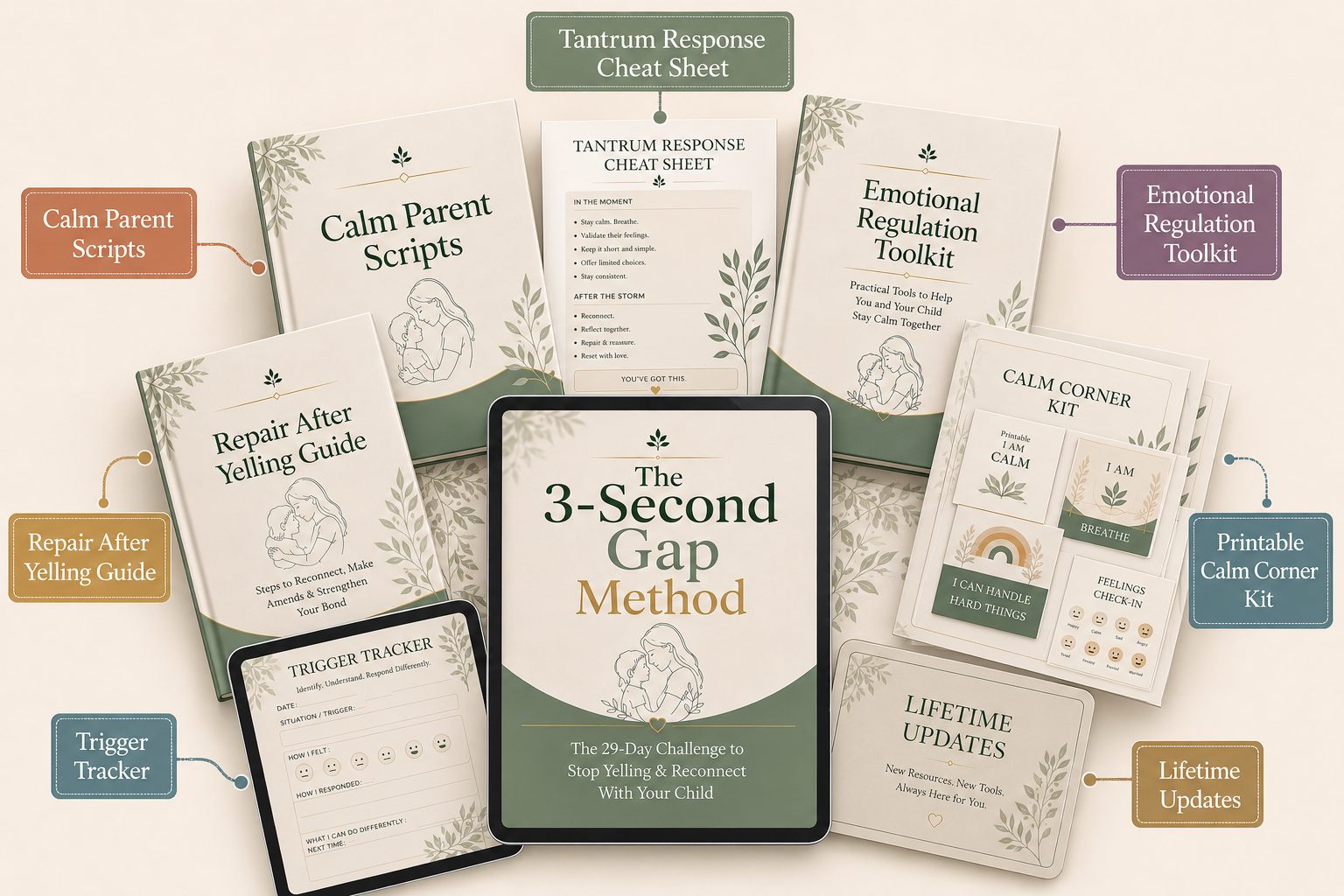
Calm Parent Scripts
Word-for-word phrases for tantrums, whining, defiance, and bedtime battles. Just open it and read the line.
Repair-After-Yelling Guide
Exactly how to reconnect with your child after a slip, so a bad moment heals instead of hardening into distance.
Tantrum Response Cheat Sheet
A single fridge-ready page for the most common flashpoints. One glance, and you know your move.
Emotional Regulation Toolkit
Quick, do-it-anywhere exercises to calm yourself down inside that 3-second gap.
Printable Calm Corner Kit
Posters, emotion charts, and calming activities to build a "calm corner" that does half the work for you.
Your Trigger Tracker
Uncover your personal yelling triggers, so you see the storm coming before it hits.
Lifetime Updates
Every future improvement to this challenge, added to your account free, forever.
Please read this before you decide, the price won't stay here
I need to be straight with you, because I don't do fake countdown timers and I never will.
This page is growing. My following climbs every single day, and more parents join this challenge every single day. I've set two thresholds, one for the size of my community, one for the number of parents inside the challenge, and the day both are crossed, two things happen:
I'm not telling you the exact numbers, because I don't want anyone gaming it, but I am telling you the truth: they're both close, and they only move in one direction.
So this isn't pressure. It's just honesty: the version of this offer you're looking at right now, everything, for $47, may genuinely not exist tomorrow. Come back next week and you could be looking at $97, no bonuses, for the same 29 days. Same method. Twice the price. None of the extras.
If you're ready, the smart move is to lock in today's price and today's bonuses now.
My "Keep Everything" Guarantee (this is on me, not you)

Here's how sure I am that these 29 days will change your home.
Join today. Do the challenge. Show up for the five minutes a day.
If by the end you don't feel the gap opening… if the yelling hasn't eased… if your home doesn't feel warmer and your child doesn't feel closer…
Then email me and I'll refund every penny, and you keep the entire challenge and all 7 bonuses anyway. You don't send anything back. You don't jump through hoops.
And I'll go one step further: I'll personally record you a short video apologizing for wasting your time. Because if this didn't help you, I should apologize, you trusted me, and I'd have let you down.
That's how much I believe in what's inside these 29 days. I'm not asking you to take the risk. I am.
You have nothing to lose here except the thing you're desperate to lose already: the yelling.
Right now, you have a choice to make.
Close this page and let tomorrow look like today.
Wake up tomorrow and make the same promise you made this morning. Mean it just as much. And watch it break again before noon.
Keep lying awake at night, replaying the look on their face. Keep carrying the guilt up the stairs. Keep telling yourself you'll figure it out eventually, on your own, someday.
Maybe it'll magically get better by itself.
(It won't. Patterns like this don't dissolve on their own. They dig deeper. You already know that, it's why you read this far.)
Give yourself 29 days.
Five minutes a day. The exact path I wish I'd had.
Picture it, one month from now. Your child does the thing that always set you off… and this time, there's a gap. You feel the old surge rise, and then you feel yourself choose. Your voice stays low. Their little shoulders don't climb toward their ears. They don't flinch.
They just look at you, and they stay.
Picture the night they climb into your lap on their own again. The unprompted "I love you, Mommy." The laughter in a room that used to hold its breath.
That home is real. I live in it now. And 625,000 parents are walking toward it with me.
For less than $2 a day, you can start walking toward it tonight.
Questions parents ask before joining
Will this work if my kids are older, not toddlers?
Yes. The 3-Second Gap is about your nervous system, and the responses inside are adapted for toddlers all the way up to teens. The triggers change with age; the method doesn't.
I've tried gentle parenting books and other programs, and they didn't work. How is this different?
Because books hand you ideas and leave you to assemble them alone, usually while you're already overwhelmed. This hands you a sequence, day by day, in order, five minutes at a time, built around the one thing those books skip: your own nervous-system reaction. You're not trying to remember 200 pages. You're just doing today's step.
"I'd read three parenting books before this and none of them told me what to do in the actual three seconds when my son is screaming and I feel that snap coming. This did. Day 2's body reset sounds too simple to work, and then it worked, the first time, in my kitchen, over spilled cereal."
 Bianca
I don't have time. I'm barely keeping my head above water.
That's exactly who this is built for. Five minutes a day, less time than you already spend feeling guilty about yelling. If you can find the time to feel bad about it, you can find the time to fix it.
"I almost didn't start because five minutes felt like a lie every program tells you. It wasn't. I did day 1 standing in my garage before the school run. Three weeks later my daughter climbed into my lap after a meltdown instead of running to her room, and I actually noticed the gap happening instead of just the yelling afterward."
 Alex
AlexWhat if I've been yelling for years? Is it too late?
It is almost never too late. Children are astonishingly ready to reconnect the moment they feel safe again. The mom in the supermarket thought she'd broken something permanent, she hadn't. Neither have you.
"My son is 6 and I'd been yelling at him since he was 2, I was certain the damage was already done. By day 19 something shifted that I can't fully explain, he started coming to find me after he got upset instead of hiding under his bed. I'm not a calm person. I'm just someone who finally has a gap where the yelling used to live."
 Susan
SusanIs this therapy? I'm not looking for therapy.
It's not therapy and it's not a diagnosis. It's a practical, structured parenting challenge. (If you're dealing with something deeper, this can sit alongside real support, but you don't need to be in therapy to do it.)
How do I get it after I pay?
Instantly. The moment you join, you get immediate access to the full 29-day challenge and all 7 bonuses, delivered straight to you, start tonight if you want to.
What if it doesn't work for me?
Then you pay nothing, you keep everything, and I send you a personal apology video. Re-read the guarantee above, the risk is entirely mine.
One last thing before you go.
This isn't a fantasy I'm painting for you. It's what's already happened inside real homes like yours:
"The night my daughter said 'I hate you' at dinner, I thought that was the end of something. It wasn't, it was day 11, and the script for that exact moment was sitting right there waiting for me. I used it instead of what I would have said a month earlier. She was in my lap ten minutes later."
 Isabella
"By day 26 I noticed I hadn't raised my voice in over a week, and I hadn't even been counting. My son still tests every limit he has, he's four, that's his job. But the gap is there now where it used to just be silence and my own voice too loud. That's the whole difference."
 Aria
AriaNow I want you to imagine something with me.
It's 29 days from now. It's evening. The house is winding down.
Your child does the exact thing that used to break you. The spill. The "no." The whine that used to go straight through your last nerve.
And you feel it rise… and then you feel the gap.
And you stay calm.
You watch their face, and instead of that flinch, instead of those shoulders climbing up toward their ears, they just… relax. Because they feel safe with you. Because they know now that they're safe with you.
Later, they climb into your lap without being asked. They tuck their head under your chin. And they say, for no reason at all, "I love you, Mommy."
And you have to blink back tears, because you remember exactly how far you both came to get here.
That moment is 29 days away. It's waiting for you.
All you have to do is take the first small step tonight.
I'll see you inside.
With love,
Catherine
Founder, Responsive Parenting Hub
P.S. Remember the guarantee: do the 29 days, and if your home doesn't change, you get a full refund, you keep the challenge and all 7 bonuses, and I send you a personal apology for your time. You genuinely cannot lose here, except the yelling.
P.P.S. The price won't stay at $47. The moment my community and the number of parents in this challenge cross two thresholds I've already set, it jumps to $97 and the 7 bonuses disappear, for good. Both numbers are close, and they only climb. If you're ready, lock in everything today, at today's price.
P.P.P.S. Every day you wait is one more morning you make that promise and watch it break by noon. One more night carrying the guilt up the stairs. One more day your child spends bracing instead of relaxing. The best day to start was the day it first got bad. The second best day is right now, for less than the cost of your coffee.